

WotLK Arena Progression Guide for New Contenders
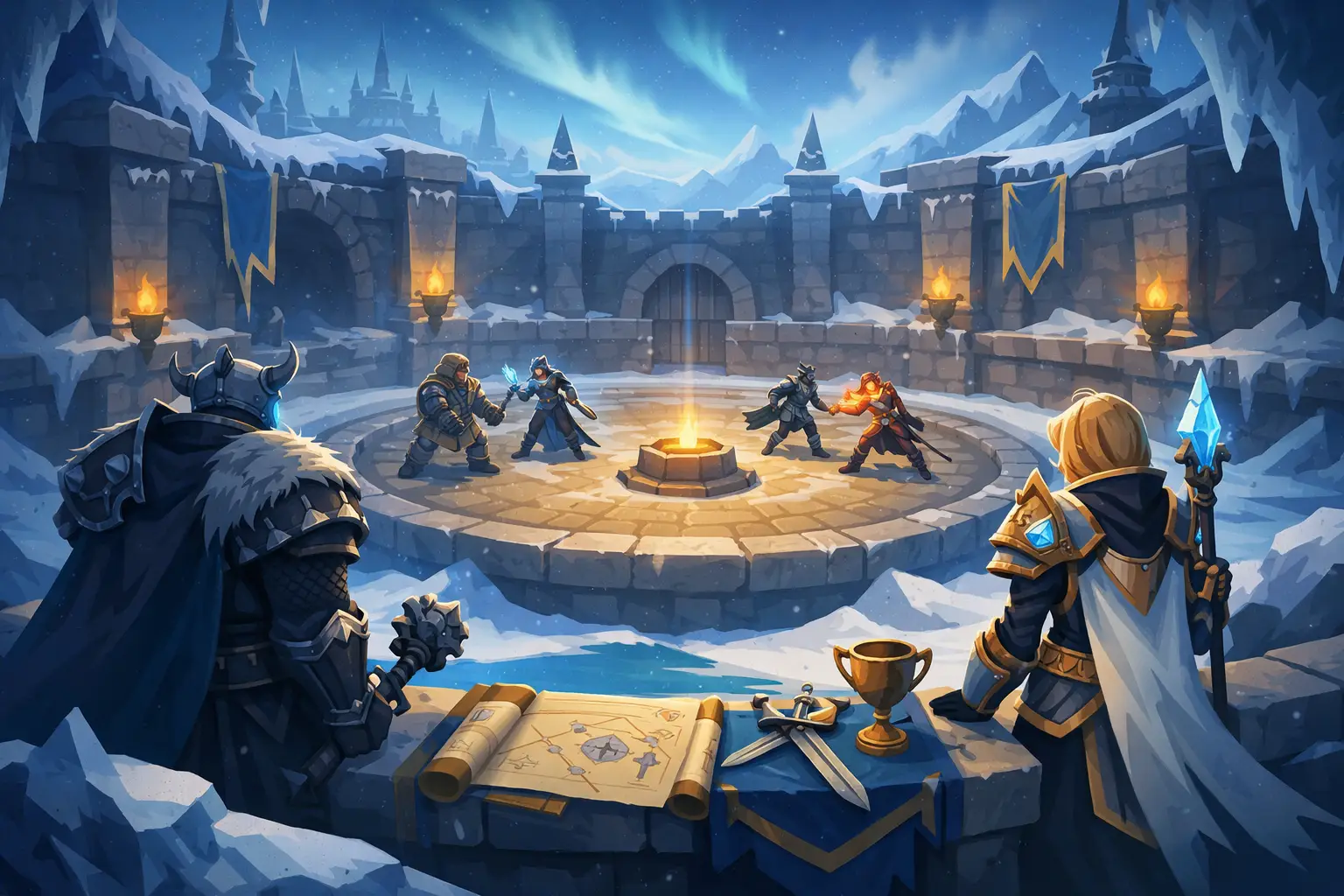
WotLK arena progression guide: build resilience gear, pick a bracket, earn weekly points, and climb the 2v2, 3v3 and 5v5 ladders on WoW-Mania 3.3.5a.
Arena in Wrath is not won by walking into Dalaran with a fresh level 80 character and hoping a strong opener carries the match. This WotLK arena progression guide is built for the longer campaign: establish a durable PvP set, learn one composition well, collect points every week, and improve the small decisions that decide close games.
For returning veterans, the systems will feel familiar. For first-time gladiators, the key is realizing that arena progression has two tracks running at once. Gear gives you room to survive mistakes. Practice teaches you how to stop making them. This guide covers both, and finishes with how a season actually works on WoW-Mania's arena ladders.
⚒️ Start With a PvP-Ready Foundation
Your first objective is not maximum damage. It is becoming difficult to kill. Resilience reduces the punishment of critical strikes and helps prevent every enemy cooldown from turning into an immediate loss. A player in complete PvE gear may look impressive on a damage meter, but in arena they are often the first target called.
Begin with honor gear wherever it gives a major resilience upgrade. Battlegrounds are the reliable starting point because they let you earn honor while learning how your class behaves against real players. Wintergrasp and its related rewards can also be worthwhile when available, especially for filling stubborn slots. Crafted PvP pieces, dungeon upgrades, and accessible raid items can help, but do not trade away large amounts of resilience simply for a higher item level.
Aim for a balanced starter set with resilience, stamina, and your primary offensive stat. Then look closely at the pieces that change how you play: trinkets, weapon, gloves, and set bonuses. A strong weapon is a meaningful upgrade for every physical damage class and many casters, but it will not replace defensive fundamentals.
PvE gear still has a place. Certain trinkets, weapons, and off-pieces can be excellent when their damage or utility justifies the resilience loss. The trade-off depends on your class, your partner, and your bracket. A disciplined team can sometimes afford a high-pressure PvE item. A new team that regularly dies in the first crowd-control chain usually cannot.
Two practical ways to make that call rather than guess: check the exact stats on a piece in the WoW-Mania armory before you spend honor or gold on it, and if you are still filling slots from PvE, heroic dungeons are the fastest route to a usable trinket or weapon while you bank points.
➡️ Build Around a Bracket You Will Actually Play
Arena points come from participation and consistency, not from saving your character for an imaginary perfect partner. Pick a bracket that suits your goals and schedule, then commit to playing enough games to learn from them.
2v2 — the easiest place to begin. Queue times are generally friendly, coordination involves only one partner, and each loss is easier to review. It also magnifies individual errors. If you overlap defensive cooldowns, miss a dispel, or let a healer drink for free, there is nowhere to hide.
3v3 — usually the richest format. Compositions have more tools, more crowd-control options, and more room for coordinated setups. It demands clearer communication, however. Before queuing, establish simple calls for target swaps, enemy cooldowns, crowd control, and retreating behind line of sight.
5v5 — the organisation test. It requires the most coordination and rewards teams that practice together. On many realms that makes it a novelty bracket, but note that WoW-Mania ranks 5v5 as its own ladder with its own end-of-season prizes, so a committed roster has a genuine target there rather than a curiosity.
On a long-running realm such as WoW-Mania, the best bracket is often the one where you can build a regular team. Reliable partners who queue twice a week will move you forward faster than a stronger player who appears once a month.
⭐ Choose a Composition Before You Chase a Rating
WotLK has famous compositions for a reason, but copying one is not enough. Your team needs a win condition you both understand. Some teams win with a long crowd-control chain on the enemy healer. Others survive the opening, force cooldowns, and win through mana pressure. Double damage teams may rely on one clean burst window.
Ask three practical questions before settling on a partner:
- Who is the usual kill target?
- What does your team do when the enemy uses major defensives?
- Which crowd-control effects should never overlap?
If neither player can answer those, the comp may still work, but the team is not ready to execute it.
Class comfort matters more than trend chasing at early ratings. A player who knows when to fake cast, peel, kite, and use every defensive button will usually outperform someone playing a supposedly superior spec with no match experience. Play the class you enjoy enough to study after a frustrating loss.
⌛ Turn Weekly Points Into Real Progress
Arena rewards are earned over weeks, so treat each reset as a checkpoint. Play the required games for your team and make sure every active character meets the participation expectations for rewards. Exact vendor prices, rating requirements, season availability, and point rules can differ by realm or season configuration, so check the in-game vendors and the current season details before planning a purchase.
Spend points where they create the biggest immediate advantage. For most players, that means a weapon, a major set piece, or an item that completes an important bonus. Do not buy a minor upgrade merely because it is available if a far more valuable piece is within reach next week.
Keep honor flowing alongside arena points. Honor purchases fill gaps, while arena rewards become your premium upgrades. This two-currency approach prevents a common mistake: waiting for arena points while entering every match with outdated defensive gear. The PvP statistics page is a useful sanity check here, since it tracks battleground records and top players across the realm while you are grinding honor.
If a rating threshold applies to the item you want, do not let that requirement become a reason to stop playing. Continue building points, improve the team, and be ready to buy when you reach the mark. Rating progress is rarely a straight line. A bad queue session can be followed by a better matchup spread, stronger communication, and a clean climb the next night.
⚡ Practice the First 30 Seconds
Most new arena teams lose the match before they recognize it. The opening determines positioning, trinket usage, crowd-control opportunities, and whether your healer can play safely. Practice it deliberately.
Before gates open, identify the likely enemy win condition. Against a setup built around an early stun and burst, decide who uses the first defensive cooldown and who keeps their trinket. Against a caster team, decide where you will fight so pillars protect your healer without separating your team.
Then make your own opening repeatable. A Rogue might sap, establish control, and wait for a coordinated swap. A Warrior might pressure aggressively while preserving mobility for the healer. A caster may begin with line-of-sight discipline rather than throwing every spell into an enemy who can interrupt freely. The details change by composition, but a planned opening is always better than two players improvising in opposite directions.
⚙️ Learn Cooldowns, Not Just Damage Rotations
A PvE rotation is useful, but arena is a cooldown game. You win exchanges by forcing more from the opponent than you spend yourself. When an enemy uses a major defensive, your team should recognize whether to swap targets, reset, crowd-control the healer, or continue pressure because the target is still vulnerable.
Track the abilities that decide games: trinkets, interrupts, major defensives, mobility tools, anti-crowd-control effects, and healing cooldowns. You do not need to announce every spell. Start with concise calls such as trinket used, no kick, healer feared, or swap now. A clean cooldown tracker helps more than raw damage meters here, and several of the addons worth installing do this job well.
This also means respecting diminishing returns. Repeating the same category of crowd control too quickly can turn a game-winning setup into a brief inconvenience. Plan your chain so each effect has value, and tell your partner when your control is unavailable.
✨ Review Losses Without Blaming the Matchup
Some matchups are genuinely difficult, particularly when both teams are equally skilled. That does not make every loss unavoidable. After a session, review two or three losses and find the first avoidable error. Maybe you fought away from a pillar. Maybe both players trinketed the same setup. Maybe a healer was left exposed while the damage dealer chased a target with every defensive active.
Keep the review specific. Saying we need better coordination does not create a change. Saying our healer will stay near the pillar against this composition and our damage dealer will save their interrupt for the first big heal does.
If you record games, use that footage to catch habits you cannot see during a match. If not, a quick discussion after each loss is enough. Protect team morale. Arena is competitive, but a partner who feels blamed will stop communicating, and silent teams stop progressing.
❄️ How an Arena Season Works on WoW-Mania
Everything above applies anywhere in Wrath. What makes a season worth planning around is knowing the local rules, and WoW-Mania publishes them openly.
Seasons run in roughly three-month blocks, and the arena page shows the active one with its exact start and end times in realm time. At the time of writing that is Season 38, running from 26 August to 26 November 2026. The same page carries the live top-20 tables for 2v2, 3v3 and 5v5.
The detail that should shape your plan: the top 3 teams in each bracket qualify for additional end-of-season prizes. Because that is per bracket rather than overall, a well-drilled 5v5 roster or a focused 2v2 pair can be competing for a prize slot without ever touching the most crowded ladder. Early in a season the tables are thin, which is the cheapest time to establish a rating before the field fills in.
Before you queue, read the WoW-Mania game rules — win trading and account sharing are the usual ways a promising season ends badly — and check the forum for the season-specific rules, which can change between seasons. If you want to see where you stand outside the arena tables, the achievement rankings and guild progression pages give a wider view of the realm, and your account's character viewer will show your current resilience and gear once you are logged in.
❓ WotLK Arena FAQ
How much resilience do you need to start arena in WotLK?
There is no single number, but a full set of entry-level honor PvP pieces is the practical starting point. The goal is not a target figure, it is surviving the opening crowd-control chain long enough for your team to answer it.
How many arena games do you need each week?
You need to meet your team's participation requirement for that week's points, and you must have played a share of your team's games to be paid. Check the in-game vendor and the current season rules, since this can vary by realm configuration.
Is 2v2 or 3v3 better for a new player?
2v2 for learning, 3v3 for climbing. 2v2 has shorter queues and simpler coordination, so mistakes are easier to spot. 3v3 offers more tools and is usually the more rewarding format once you have a reliable pair of partners.
Can you use PvE gear in arena?
Yes, selectively. Certain trinkets and weapons are strong enough to justify the resilience loss, but a new team that keeps dying in the first setup should prioritise resilience over item level.
When does the current arena season end on WoW-Mania?
Season 38 runs until 26 November 2026, realm time. The arena page always shows the active season's dates and the current standings.
✅ Progress With Patience and Purpose
Your rating matters, but it is not the only proof of progress. A cleaner opener, better use of line of sight, a successful cross crowd-control chain, or a disciplined reset against a burst team are all signs that your team is becoming harder to beat.
Set one improvement goal per session. It might be calling enemy trinkets, avoiding overlapping defensives, or making target swaps faster. Gear will arrive through steady weekly effort. The habits that make that gear count are forged one hard-fought queue at a time. Keep showing up, trust your partner, and let every match add another chapter to your arena legend. The ladders are waiting.